
Last Updated: July 15, 2026
Reviewed by: A licensed veterinarian for medical accuracy
Disclosure: This article contains no affiliate links and is fully independent editorial content. All information verified as of July 2026.
Medical Disclaimer: This article is for educational purposes only and is not a substitute for professional veterinary diagnosis or treatment. Always consult a licensed veterinarian before starting any home treatment for your dog.
Key Takeaways
→ Most cases of dog digestive upset resolve within 24–72 hours with proper home care
→ A short controlled fast followed by bland diet is the most commonly recommended first response
→ Boiled chicken, white rice, and plain pumpkin are the three most evidence-backed home remedies
→ Blood in vomit or stool, bloating, or continuous vomiting requires immediate vet care
→ The D.O.G. Recovery Protocol gives you a clear three-phase path from first symptom to full recovery
Introduction
If your dog is hunched over, refusing food, or you just cleaned up a mess on the kitchen floor for the third time today, I want you to know something first. You are not overreacting by worrying, and you are not the only pet parent sitting on the floor at midnight searching for what is wrong with their dog.
An upset stomach in dogs is one of the most common reasons pet owners reach out to a vet, and in most cases it is manageable at home with patience and the right approach. Most cases of vomiting and diarrhea in dogs are mild and self-limiting, resolving with supportive care rather than surgery, though care should be sought if a dog stops eating, becomes lethargic, or symptoms don’t resolve within 48–72 hours (Cornell University College of Veterinary Medicine, Riney Canine Health Center). https://www.vet.cornell.edu/departments-centers-and-institutes/riney-canine-health-center/canine-health-topics/diarrhea
The right remedy for dog upset stomach depends on the symptoms, your dog’s age, and how quickly you act. This guide walks you through what is safe to try, what to avoid, and the specific moments when home care is not enough and a vet visit becomes necessary.
Choosing the right remedy for dog upset stomach early can help your dog recover faster while reducing the risk of dehydration or more serious complications. This guide explains the safest and most effective treatment options recommended by veterinarians.
In this guide you will learn:
→ What is actually happening in your dog’s body during an upset stomach
→ How to read your dog’s discomfort level accurately
→ The most effective home remedies for dog upset stomach ranked by evidence
→ What to avoid that could make things worse
→ The D.O.G. Recovery Protocol — a clear three phase framework
→ Exactly when to stop home treatment and call your vet
This guide covers everything most dog owners need to know about treating a mild upset stomach safely at home. Bookmark it now — you will want it the next time your dog has a rough digestive day.

Veterinary Note: For most mild cases — withhold food for 12 hours while always keeping fresh water available, then introduce boiled chicken and white rice in a 2:1 ratio. Add plain canned pumpkin for diarrhea. Monitor closely. Blood in vomit or stool means go to the vet immediately. Always confirm this approach with your veterinarian for your specific dog.
Table of Contents
- Understanding dog diarrhea
- How Serious Is It — Reading Your Dog’s Discomfort Level
- Home Remedies for Dog Upset Stomach That Actually Help
- The Bland Diet Remedy for Dog Upset Stomach
- What to Avoid When Your Dog Has an Upset Stomach
- Natural Remedies for Dog Upset Stomach
- Homeopathic Remedies for Dog Upset Stomach: What the Evidence Says
- The D.O.G. Recovery Protocol
- Common Causes and What They Mean for Treatment
- Remedy for Dog Upset Stomach Comparison Table
- Step-by-Step Remedy for Dog Upset Stomach: First 24 Hours
- Common Myths About Dog Upset Stomach
- Remedy for Dog Upset Stomach: Small Dogs vs. Large Dogs
- Remedy for Dog Upset Stomach: Puppies vs. Senior Dogs
- When to Stop Reading and Call Your Vet
- What to Expect During a Vet Visit
- Nutrition After Recovery
- Prevention Tips for Dog Digestive Upset in 2026
- Building a Simple Stomach Upset Recovery Kit
- Signs Your Dog Is Actually Getting Better
- Conclusion
- FAQ — People Also Ask
- How This Article Was Made
- Sources and References
Understanding Dog Diarrhea
Dog Diarrhea is a common digestive problem in dogs and can affect dogs of any age or breed. It happens when the gut can’t absorb enough water, resulting in loose or watery stools. Dog Diarrhea is often caused by a sudden change in diet, eating food that has gone bad, stress or a mild stomach upset.
Most episodes respond to supportive home care within 24 to 48 hours, but some require immediate veterinary care.
It’s just as important to watch your dog’s energy level, appetite, and hydration as it is to watch the stool itself. Persistent diarrhea, blood in the stool, repeated vomiting or signs of dehydration should never be ignored.
Knowing what is causing your dog’s diarrhea will help you decide on the right treatment and know when home remedies are no longer enough.
Acute Versus Chronic Stomach Upset
It helps to understand there are really two different categories of stomach trouble in dogs, and they call for different responses.
Acute upset comes on suddenly, usually within hours, and is often tied to something specific like a diet change or an item your dog should not have eaten. This is the type most home remedies are designed for, and it typically resolves within a few days.
Chronic upset happens repeatedly over weeks or months, sometimes with normal days in between. This pattern often points to something ongoing such as a food sensitivity, a parasite that never fully cleared, or an underlying digestive condition. Chronic cases are not something home remedies alone should manage long term, and they deserve a proper veterinary workup.
Why the Gut Reacts the Way It Does
Your dog’s digestive tract is lined with sensitive tissue that responds quickly to irritation. When something disrupts that lining — whether bacteria, a foreign substance, or dietary change — the body increases motility to move things through faster and may trigger the vomiting reflex as a protective measure. This explains why supportive care that reduces demand on the gut, like a short fast and a bland diet, tends to work so well for common cases.
2. How Serious Is It — Reading Your Dog’s Discomfort Level
Not every upset stomach looks the same, and knowing where your dog falls on the discomfort scale helps you decide how urgently to act.
Mild discomfort looks like a dog who is a little quieter than usual, maybe skips one meal, has one loose stool, but is still drinking water, still wagging their tail when you walk in the room, and still responsive to you. This level usually settles within a day with simple home care.
Moderate discomfort looks like repeated vomiting or diarrhea over several hours, a dog who seems restless or keeps getting up and lying back down, mild lip smacking or drooling that suggests nausea, and reduced interest in food or water. This level needs closer monitoring and often benefits from the home remedies below, but you should watch closely for any worsening.
Severe discomfort looks like a dog who is lethargic and hard to rouse, repeated vomiting that will not stop, blood in vomit or stool, a swollen or hard belly, or visible pain when you touch their abdomen. This level is not something to manage at home.
How to Check for Dehydration at Home
Dehydration is one of the biggest risks with any stomach upset that involves vomiting or diarrhea, and it can develop faster than people expect, especially in smaller dogs.
The skin tent test: Gently lift the skin between your dog’s shoulder blades and let go. In a well hydrated dog, the skin snaps back almost instantly. If it takes a second or two to settle, or stays tented, that is a sign of dehydration worth calling your vet about.
The gum check: Press a finger gently against your dog’s gum until it turns white, then release. The color should return to pink within about two seconds. Gums that are pale, tacky, or slow to return to color can indicate dehydration or a more serious underlying issue.
Keeping a Simple Symptom Log
If your dog’s upset stomach continues into a second day, keeping a short written log genuinely helps. Note the time of each vomiting or diarrhea episode, whether water was consumed, whether any food was offered and how your dog responded, and general energy level throughout the day.
This log becomes incredibly useful if you end up calling your vet, since it lets them make a faster and more accurate assessment.

3. Home Remedies for Dog Upset Stomach That Actually Help
Good news. Most cases of digestive upset in dogs respond well to simple home care. You do not need expensive treatments or a vet visit for every episode. These are the remedies most commonly recommended by veterinarians for mild to moderate cases.
Finding the best remedy for dog upset stomach usually starts with simple home care. Most mild digestive problems improve with hydration, short-term fasting (when appropriate), and a bland diet.
Withholding Food Briefly
Many owners are surprised that the first step in treating an upset stomach is to stop feeding entirely.
For a healthy adult dog with no other conditions, many vets recommend withholding food for 12 hours as a simple remedy for dog upset stomach, while offering small amounts of water frequently.
This isn’t appropriate for puppies, senior dogs, or dogs with diabetes or other medical conditions, as even brief fasting can cause complications. Always confirm the right remedy for dog upset stomach with your vet for your specific dog.
Keep fresh water available at all times — never restrict it during a digestive episode unless your vet says otherwise. Dehydration from vomiting and diarrhea is the fastest way a mild upset becomes a medical emergency.
Plain Canned Pumpkin
Is pumpkin good for dogs with upset stomach? Yes. Plain canned pumpkin is one of the most commonly recommended natural remedies by veterinarians for dog digestive issues.
This one genuinely surprises people. A plain can of pumpkin sitting in your pantry is one of the most effective tools you have — and most dog owners have never tried it.
Pumpkin contains soluble fiber that may help absorb excess water in the intestines, which can help with diarrhea. That same fiber adds bulk that may help with constipation. It also contains zinc, potassium, and Vitamin A, all of which support gut lining integrity.
→ Small dogs: 1 teaspoon mixed into bland meal
→ Large dogs: 1 tablespoon mixed into bland meal
→ Form: 100% plain canned pumpkin puree, not pumpkin pie filling
Pro Tip: Keep a can of plain pumpkin puree in your pantry permanently. It costs under $3, lasts months on the shelf, and works as both a remedy and a food topper for picky eaters.
Probiotics Formulated for Dogs
Think of probiotics as reinforcements for your dog’s gut. They may help replenish beneficial bacteria lost due to vomiting or diarrhea and may help speed recovery when used correctly.
Look for products specifically labeled for canine use, since human probiotics are formulated differently. Purina Pro Plan Fortiflora and Nutramax Proviable are among the most commonly recommended by veterinarians.
Consult your vet before starting any probiotic supplement. Not every product suits every dog.
Plenty of Fresh Water and Bone Broth
Hydration matters more than almost anything else during a stomach upset, especially if there has been vomiting or diarrhea. Offer small amounts frequently rather than a large bowl all at once, since gulping water can sometimes trigger more vomiting.
When your dog refuses to drink plain water, plain low-sodium bone broth can encourage fluid intake. Use broth with no onion, no garlic, and no xylitol. It provides some hydration along with a bit of flavor that many dogs find appealing when they are not feeling well.
For dogs prone to gulping, offering an ice cube to lick can slow down water intake naturally and reduce the chance of triggering more nausea.
Rest in a Calm Quiet Space
Stress and overstimulation can worsen digestive symptoms. A quiet corner away from household noise, other pets, and young children gives your dog’s body a better chance to settle and recover.

4. The Bland Diet Remedy for Dog Upset Stomach
What is a bland diet for a dog with upset stomach?
A bland diet is defined as a short-term feeding plan of easily digested, low-fat, low-fiber foods designed to rest the gastrointestinal tract while providing minimal but adequate nutrition for recovery.
For many healthy adult dogs, a bland diet remains the most trusted remedy for dog upset stomach because it gives the digestive system time to heal while providing easy-to-digest nutrition.
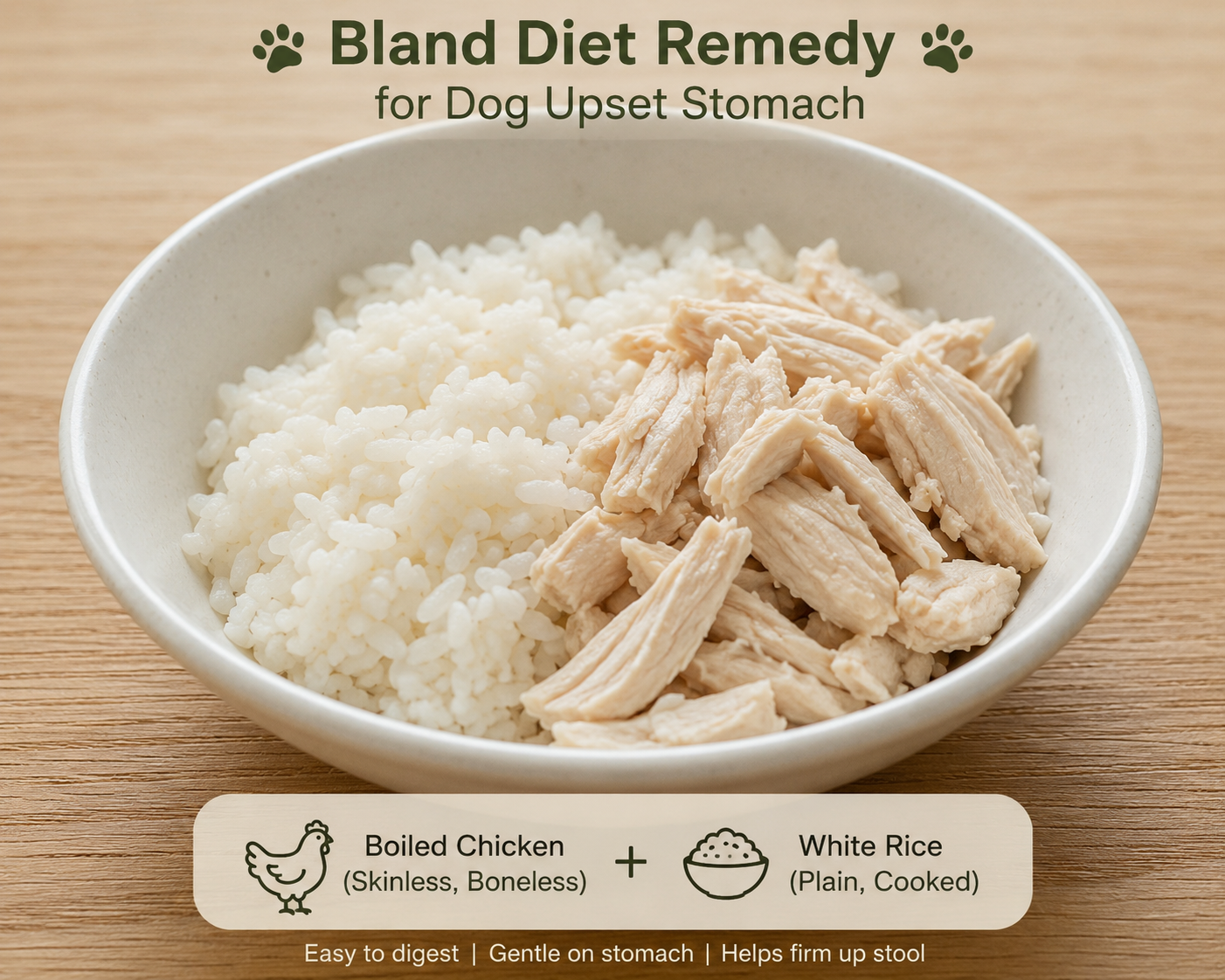
Is chicken and rice good for dogs with upset stomach?
Yes. Boiled chicken and rice is the #1 vet recommended remedy for dog upset stomach because it is easy to digest and is one of the most commonly recommended bland diets by veterinarians for decades. White rice is low in fiber, highly digestible, and may help firm up loose stools. Plain boiled chicken with no skin, no seasoning, and no oil provides lean protein without the fat that could worsen GI inflammation.
Bland food gives your dog’s stomach the break it needs. Think of it as the dog version of eating plain toast when you are sick — simple, easy to digest, and gentle enough to stay down.
How to Build a Bland Diet — Step by Step
Step 1: Complete the fast
After your dog’s last vomiting episode, withhold food for 12 hours for adult dogs or 6–8 hours for puppies and small breeds. Always keep fresh water available throughout. Confirm fasting duration with your vet, especially for puppies, senior dogs, and diabetic dogs.
Step 2: Prepare the protein
Boil boneless, skinless chicken breast in plain water. No salt, no oil, no seasonings of any kind. Shred into small pieces once cooled to room temperature.
Step 3: Cook the rice
Use plain white rice, not brown rice, which contains too much fiber for a recovering gut. Cook in plain water only with no broth, no butter, and no seasoning.
Step 4: Mix in the correct ratio
Combine 2 parts white rice to 1 part chicken. Start with small amounts, roughly 1 tablespoon per 10 lbs as a general starting point. Adjust based on your dog’s response and consult your vet for precise guidance.
Step 5: Feed small and frequent
Offer 3–4 small portions spread throughout the day rather than 1–2 large meals. This helps avoid overwhelming a digestive system that is still recovering.
Step 6: Add pumpkin if diarrhea continues
Mix 1–2 tablespoons of plain canned pumpkin into each serving to help firm loose stools.
Step 7: Transition back to regular food gradually
After 2–3 days of normal stools, begin the transition back over 5–7 days:
→ Days 1–2: 25% regular food, 75% bland diet
→ Days 3–4: 50% regular food, 50% bland diet
→ Days 5–6: 75% regular food, 25% bland diet
→ Day 7: 100% regular food
Bland Diet Meal Plan by Dog Weight
| Dog Weight | Portion Per Meal | Meals Per Day | Pumpkin Add-On |
|---|---|---|---|
| Under 10 lbs | 2–3 tablespoons | 4 meals | ½ teaspoon |
| 10–25 lbs | ¼ cup | 4 meals | 1 teaspoon |
| 25–50 lbs | ½ cup | 3–4 meals | 1 tablespoon |
| 50–75 lbs | ¾ cup | 3 meals | 2 tablespoons |
| Over 75 lbs | 1–1.5 cups | 3 meals | 2–3 tablespoons |
These are general starting points only. Always consult your vet for precise portion guidance.
Bland Diet Substitutes When Chicken Is Not Available
→ Lean ground turkey, boiled with fat fully drained
→ Boiled eggs, easily digestible and high in protein
→ Low-fat cottage cheese for dogs without dairy sensitivity
→ Boiled sweet potato in place of white rice
→ Plain cooked oatmeal with no sugar or flavoring
5. What to Avoid When Your Dog Has an Upset Stomach
Just as important as what to do is what to steer clear of while your dog is recovering.
→ Do not give human medications like Pepto-Bismol, Imodium, or Tums without talking to your vet first. Some human medications are toxic to dogs and others need very specific dosing based on your dog’s weight and health history. Giving human medicine without vet approval is never a safe remedy for dog upset stomach.
→ Do not switch to a new commercial food during this period, even if it is marketed as a sensitive stomach formula. Introducing anything new while the gut is inflamed can make things worse.
→ Do not offer dairy products like milk or cheese to settle the stomach. Many dogs are lactose intolerant and dairy can actually worsen diarrhea.
→ Do not force feed a dog who is actively nauseous or vomiting. Let their body settle first and reintroduce food gradually once vomiting has stopped for several hours.
→ Do not give bones, rawhide, or rich fatty treats while your dog is recovering. Fatty foods in particular can trigger or worsen pancreatitis, a painful and serious condition that shares many symptoms with ordinary stomach upset.
→ Do not assume every dog handles a brief fast the same way. Toy breeds and small dogs can develop low blood sugar more quickly than larger breeds, so even a short food withholding period should be watched closely.
A Special Note on Puppies, Seniors, and Dogs with Existing Conditions
Puppies under six months old have much smaller energy reserves and can become dangerously low on blood sugar within just a few hours of not eating. Withholding food for a puppy with an upset stomach is generally not recommended without direct veterinary guidance.
Senior dogs, particularly those with kidney disease, heart disease, or diabetes, can decline quickly from dehydration or a missed dose of medication that depends on food intake. Any stomach upset in a senior dog with an existing health condition deserves a call to your vet early rather than a wait and see approach.
6. Natural Remedies for Dog Upset Stomach
A natural remedy for dog upset stomach can support recovery when used alongside proper hydration and veterinary guidance. Always introduce herbal remedies carefully and monitor your dog’s response.
Natural remedies for dog upset stomach go beyond food. They include herbs, supplements, and plant-based compounds that may support digestive healing from the inside out.
Slippery Elm Bark
Slippery elm is defined as a botanical remedy derived from the inner bark of Ulmus rubra. It contains mucilage, a gel-like substance that may coat and soothe inflamed mucous membranes throughout the GI tract.
Although slippery elm is not widely known, it has a good reputation in holistic veterinary medicine. It may form a protective barrier inside your dog’s gut that helps reduce irritation and supports faster recovery. It may also act as a mild prebiotic, supporting beneficial gut bacteria while protecting irritated tissue.
→ Dosing: ¼ teaspoon of powdered bark per 10 lbs of body weight, mixed into food
→ Frequency: 2–3 times daily during an active episode
→ Caution: Space at least 2 hours apart from any medications
These are general guidelines only and may not be appropriate for every dog. Always consult your veterinarian before introducing slippery elm.
Ginger
Ginger is not just for humans. Small amounts may help dogs dealing with nausea, and most dogs will eat it mixed into food or bone broth without resistance.
Ginger contains gingerols and shogaols, bioactive compounds that may help accelerate gastric emptying and reduce nausea signals. Some human and animal research suggests ginger compounds may help reduce nausea, though evidence specific to dogs remains limited.
→ Small dogs: ¼ teaspoon of fresh grated ginger or a pinch of ground ginger
→ Medium dogs: ½ teaspoon
→ Large dogs: ¾ teaspoon
→ Avoid if your dog takes blood-thinning medications or NSAIDs
These are general examples only. Consult your veterinarian before introducing ginger to your dog’s diet.
Chamomile Tea
If your dog is also crampy or gassy, chamomile tea may help. It may soften gut muscles and reduce bloating. Evidence in dogs specifically is limited, but chamomile has documented anti-spasmodic properties in general research.
→ Brew one tea bag per cup of water, cool fully to room temperature before offering
→ Add 1–3 tablespoons to food or water depending on your dog’s size
→ Avoid if your dog takes blood-thinning medications
Marshmallow Root
Some holistic veterinarians also use marshmallow root for its similar soothing properties to slippery elm. These should always be sourced from products made specifically for dogs, since human herbal preparations often contain other ingredients or concentrations not appropriate for dogs.
Coconut Oil — Avoid as a Home Remedy
Many pet websites recommend coconut oil for digestive upset. Do not follow that advice. Coconut oil is high in saturated fat, which can trigger or significantly worsen pancreatitis in dogs. Consult your vet before using coconut oil for any reason related to digestive health.
7. Homeopathic Remedies for Dog Upset Stomach — What Evidence Says
Truthfully, this is one of those topics where pet owners deserve a straight answer, not vague reassurance.
Homeopathic remedy for dog’s upset stomach refers to ultra-diluted preparations used in alternative veterinary medicine with the intention of stimulating the body’s self-healing response.
Commonly cited homeopathic options include Nux Vomica for vomiting after dietary excess, Arsenicum Album for vomiting and diarrhea together, and Pulsatilla for nausea in sensitive or anxious dogs.
Multiple systematic reviews in veterinary literature, including assessments published through 2022, found that high-quality evidence has not shown homeopathic remedies to perform better than placebo for any condition in animals or humans.
This is critically different from herbal remedies like ginger or slippery elm, which contain measurable active compounds with documented biological effects. Always discuss any homeopathic treatment with your veterinarian before trying it.
8. The D.O.G. Recovery Protocol
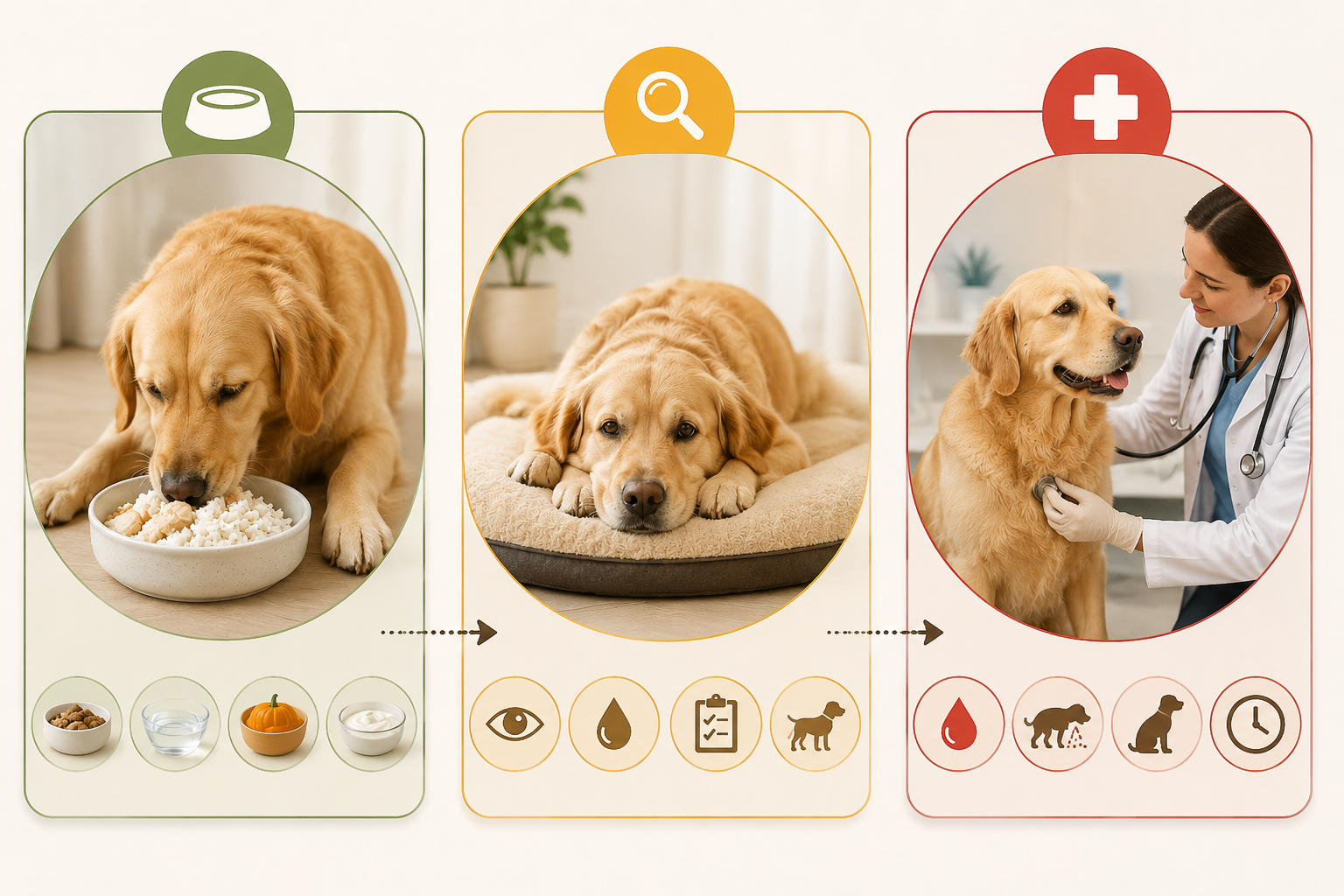
The D.O.G. Recovery Protocol is a simple framework designed to help pet owners respond systematically to mild digestive upset. It gives you a clear path forward instead of guesswork.
The D.O.G. Recovery Protocol is defined as a three-phase structured response system for managing canine digestive upset, from first symptom identification through complete dietary restoration.
Phase D — Diagnose and Decide (Hours 0–2)
Do not panic. Observe and assess first.
Ask yourself:
→ Is this the first episode or part of a recurring pattern?
→ Did my dog eat anything unusual in the last 24 hours?
→ Are any red-flag symptoms present such as bloating, blood, or extreme lethargy?
If red flags are present: go directly to your vet or emergency animal hospital immediately.
If no red flags: proceed to Phase O.
Phase O — Offset the Damage (Hours 2–24)
→ Remove food but never water
→ Begin the controlled fast and confirm appropriate duration with your vet
→ Offer plain low-sodium bone broth if your dog refuses plain water
→ Monitor and log stool frequency, consistency, and any vomit characteristics
→ Prepare probiotics to introduce when you reintroduce food
Phase G — Gradual Restoration (Days 2–5)
→ Start the bland diet with chicken and rice in a 2:1 ratio
→ Feed 3–4 small meals rather than 1–2 large ones
→ Add plain pumpkin puree if stools remain loose
→ Introduce ginger or chamomile tea as natural anti-nausea support
→ Transition back to regular food over 5–7 days once stools normalize
Expert Insight: Many integrative veterinarians emphasize that reintroducing food too quickly after vomiting is one of the most common mistakes pet owners make. Starting with very small amounts, a tablespoon at a time, gives the recovering digestive system the best chance to heal.
9. Common Causes and What They Mean for Treatment
Dietary indiscretion, the medical term for a dog eating something they should not have, usually causes short-lived vomiting or diarrhea that responds well to the bland diet approach.
Sudden food changes often cause loose stool without vomiting. The fix here is a slow transition over 7–10 days when introducing any new food going forward.
Stress-related stomach upset can happen after travel, boarding, a new household member, or a change in routine. This usually resolves as the stress source passes, alongside the bland diet.
Parasites like Giardia or intestinal worms cause ongoing or recurring diarrhea that does not fully resolve with home care. This requires a vet visit and a stool sample test.
Bacterial or viral infections can cause more intense symptoms including fever and typically need veterinary diagnosis.
Food sensitivities and allergies tend to cause recurring digestive upset tied to a specific ingredient, most often a particular protein source. These cases often need an elimination diet trial guided by a vet.
Pancreatitis, often triggered by a high-fat meal or table scraps, causes more intense vomiting, abdominal pain, and lethargy. This condition requires veterinary diagnosis through bloodwork.
Foreign object ingestion such as swallowing a toy piece or sock can cause vomiting that does not improve with fasting and bland diet. This requires imaging at a vet clinic to rule out a blockage.

10. Remedy for Dog Upset Stomach Comparison Table
Remedy for Dog Upset Stomach — Top Options at a Glance
| Remedy | Best For | Pros | Cons | Approximate Cost | Evidence |
|---|---|---|---|---|---|
| Bland Diet — Chicken and Rice | Mild vomiting or diarrhea | Easy to digest, ingredients most homes already have | Not a long term diet | Under $5 per meal | ⭐⭐⭐⭐⭐ Strong |
| Plain Canned Pumpkin | Loose stool, mild diarrhea | Adds fiber, most dogs like the taste | Will not help vomiting on its own | $2–4 per can | ⭐⭐⭐⭐ Good |
| Canine Probiotics | Restoring gut bacteria | Supports long term gut health | Takes days to show full effect | $15–30 per bottle | ⭐⭐⭐⭐⭐ Strong |
| Brief Food Withholding | Mild vomiting in healthy adult dogs | No cost, gives stomach a rest | Not safe for puppies, seniors, diabetic dogs | Free | ⭐⭐⭐⭐ Good |
| Slippery Elm | Soothing irritated gut lining | Gentle holistic option | Needs correct dosing, not for every case | $10–20 per bottle | ⭐⭐⭐ Moderate |
| Bone Broth | Encouraging hydration | Easy for reluctant drinkers | Not a treatment on its own | $3–8 per container | ⭐⭐⭐ Moderate |
| Ginger | Nausea, motion sickness | Natural, easy to add to food | Limited dog-specific research | Very Low $ | ⭐⭐⭐ Moderate |
| Homeopathic Remedies | Not recommended standalone | — | No proven mechanism | $10–20 | ⭐ Weak |
Winner for most cases: The combination of controlled fasting, bland diet, plain pumpkin, and probiotics delivers the most evidence-backed, cost-effective remedy for dog upset stomach in mild to moderate cases.
11. Step-by-Step Remedy for Dog Upset Stomach: First 24 Hours
If you’re looking for the most effective remedy for dog upset stomach, following these first 24-hour steps can make a significant difference in your dog’s recovery.
Step 1: Observe your dog closely for the first hour after symptoms start. Note whether it is vomiting, diarrhea, or both, and whether there is any blood.
Step 2: Remove access to food for 12 hours if your dog is a healthy adult, while offering small sips of water frequently.
Step 3: Watch for any worsening signs like repeated vomiting, lethargy, or a swollen belly. Call your vet immediately if these appear.
Step 4: Once 12 hours have passed and vomiting has stopped, offer a small portion of the boiled chicken and rice bland diet.
Step 5: Continue small, frequent bland meals for 2–3 days, gradually increasing portion size as your dog’s stomach settles.
Step 6: Slowly reintroduce your dog’s regular food over 5–7 days, mixing in increasing amounts with the bland diet.
Step 7: Contact your vet if symptoms have not fully resolved within 48 hours, even if they seem mild.
12. Common Myths About Dog Upset Stomach
Myth: Dogs eat grass to make themselves vomit when their stomach hurts.
Fact: Most veterinary behaviorists agree that grass eating is a common, mostly normal dog behavior and does not always relate to nausea. Some dogs eat grass simply because they enjoy the texture or taste. Only a small percentage of grass eating episodes are followed by vomiting.
Myth: A dry nose means a sick dog.
Fact: Nose temperature and moisture have nothing reliable to do with digestive illness. Focus on actual symptoms like appetite, energy, and stool instead.
Myth: You should always induce vomiting if your dog ate something bad.
Fact: Inducing vomiting is dangerous in certain situations, such as if the dog swallowed something sharp, a corrosive substance, or if significant time has passed. This should only be done under direct guidance from a veterinarian or poison control, never as a blanket home remedy.
Myth: Rice alone will fix any upset stomach.
Fact: Rice provides bulk and easy digestion, but it is not a complete treatment on its own, especially for cases involving infection, parasites, or an underlying condition.
Myth: If your dog seems fine between episodes, there is nothing to worry about.
Fact: Recurring stomach upset, even with normal days in between, can point to an underlying chronic condition like food sensitivities or inflammatory bowel disease that deserves a vet’s attention.
13. Remedy for Dog Upset Stomach: Small Dogs vs. Large Dogs
It is important to know that not every dog reacts to digestive upset the same way. Size matters more than you might think, and getting this wrong can quickly become an emergency.
Small breeds like Chihuahuas and Toy Poodles dehydrate significantly faster than large breeds and cannot safely fast for extended periods. Large and deep-chested breeds like Great Danes, Dobermans, and German Shepherds carry a much higher risk of gastric dilatation-volvulus (GDV). Any sign of abdominal distension in these breeds is an emergency, not a home remedy situation.
| Factor | Small Breeds | Large Breeds |
|---|---|---|
| Safe fast duration | Generally 6–8 hours. Confirm with vet | Generally up to 12 hours. Confirm with vet |
| Bloat or GDV risk | Low | High. Go to vet immediately |
| Pumpkin dose | 1 teaspoons | 1 tablespoons |
| Portion size per feeding | 1–3 tablespoons | ¼ to 1½ cups adjusted to response |
| Dehydration speed | Fast. Monitor very closely | Slower but still serious |
14. Remedy for Dog Upset Stomach: Puppies vs. Senior Dogs
Puppies and senior dogs need different handling — what’s a safe remedy for dog upset stomach in a healthy adult can be harmful for them.
Puppies — Extra Caution Required
Don’t fast puppies without vet guidance. Their smaller glycogen reserves mean hypoglycemia can develop within hours. Watch for trembling, weakness, glassy eyes, or collapse — all require immediate vet care.
Senior Dogs — Underlying Conditions Change Everything
Dogs over 7–8 years often have conditions like kidney disease, diabetes, Cushing’s, or hypothyroidism that complicate any remedy for dog upset stomach tried at home. Flag any digestive episode in a senior dog to your vet within 24 hours, even if mild — it could be an early sign of something more serious.
15. When to Stop Reading and Call Your Vet
Home remedies help with mild cases, but they have limits. A remedy for dog upset stomach is not appropriate once you see:
→ Vomiting that won’t stop
→ Blood in vomit or stool (bright red or coffee-ground dark)
→ A swollen, hard, or painful abdomen
→ Lethargy — difficult to wake or unresponsive
→ Repeated retching with nothing coming up (possible bloat)
→ Known ingestion of chocolate, xylitol, grapes, or a household chemical
→ Any of these signs in a puppy, senior, or dog with an existing condition
No remedy for dog upset stomach replaces urgent care here. Please make the call.

16. What to Expect During a Vet Visit
If you do need to bring your dog in, knowing what typically happens can ease some of the worry.
Your vet will usually start with a physical exam, checking your dog’s abdomen for pain or swelling, checking gum color and hydration, and listening to heart and lungs. Depending on severity and history, they may recommend bloodwork to check organ function and rule out pancreatitis, a fecal test to check for parasites, or imaging such as an x-ray or ultrasound if a blockage or bloat is suspected.
Treatment often includes anti-nausea medication, subcutaneous or intravenous fluids if your dog is dehydrated, and sometimes a prescription bland diet to take home. Most dogs who are treated for uncomplicated stomach upset go home the same day and recover within a few days.
Bringing the symptom log mentioned earlier, along with information about any recent diet changes, new treats, or possible access to something your dog should not have eaten, genuinely speeds up an accurate diagnosis.
17. Nutrition After Recovery
Once your dog is fully back on their regular food, it is worth thinking about long-term digestive support rather than just moving on.
Fiber balance matters. Diets that are either too low or too high in fiber can both contribute to loose stool over time. If your dog has had more than one episode of stomach upset in a short period, it is worth discussing fiber content of their regular food with your vet.
Protein source consistency helps. Dogs who do well on a single, consistent protein source sometimes struggle when owners frequently rotate between many different proteins and flavors. Introducing one new item at a time makes it much easier to identify what caused an issue if one comes up.
Treats count as food changes too. A new bag of treats or a dental chew introduced for the first time is still a dietary change from your dog’s gut perspective.
Consider a food and symptom journal for sensitive dogs. For dogs who seem to have a sensitive stomach as a general pattern, keeping a simple journal of what they eat and how their stool looks each day can reveal patterns that are otherwise easy to miss.
18. Prevention Tips for Dog Digestive Upset in 2026
After experiencing just one bad digestive episode with your dog, you never want it to happen again. These habits may help reduce how often it occurs:
→ Transition food gradually: switch to any new food over 7–10 days. Never switch brands overnight
→ Secure your trash: dietary indiscretion is the leading preventable cause of digestive upset in dogs
→ No table scraps: especially fatty, spicy, heavily seasoned, or processed human food
→ Regular deworming schedule: ask your vet about the right schedule for your dog
→ Ask your vet about probiotics: they are not necessary for every healthy dog but may help some
→ Maintain a consistent daily routine: keeping feeding times and walk schedules stable may reduce stress-related digestive upset
→ Supervise outdoor time: many episodes start with something your dog picked up outside
→ Schedule regular vet checkups: routine wellness visits catch underlying conditions before they cause recurring digestive problems
19. Building a Simple Stomach Upset Recovery Kit
Many pet parents find it helpful to keep a small kit of supplies on hand before an episode even happens, so there is no scrambling at ten at night.
A recovery kit worth keeping in your pantry includes:
→ Plain white rice
→ A package of boneless skinless chicken breast you can keep frozen
→ A can of plain pumpkin puree with no added sugar or spice
→ A veterinary formulated probiotic with a reasonable shelf life
→ Low-sodium bone broth without onion or garlic
Also keep saved somewhere easy to find:
→ Your regular vet’s phone number
→ The number of the nearest emergency animal hospital
→ Your dog’s current weight, since many medication and dosing questions during an emergency call depend on knowing this number quickly
20. Signs Your Dog Is Actually Getting Better
It helps to know what recovery looks like in real time. A dog who is recovering well will:
→ Start showing interest in food again
→ Have stool that is gradually firming up rather than staying loose
→ Return to a more normal energy level and want to interact with you
→ Keep water and small bland meals down without vomiting
If you see these signs consistently over 24–48 hours, you are generally on the right track. If instead you see any backsliding, such as vomiting returning after it seemed to stop, that is worth a call to your vet even if the earlier episode did not seem severe enough to warrant one.
Many pet owners ask which remedy for dog upset stomach works the fastest. The answer depends on the underlying cause, but hydration, a bland diet, and close monitoring remain the most effective first-line treatments for mild cases.
21. Conclusion
Watching your dog experience an upset stomach can be stressful, but many mild cases improve with a bland diet, proper hydration, and careful monitoring. The right remedy for dog upset stomach depends on the underlying cause, so it’s important to choose safe, vet-approved treatments.
If your dog develops severe symptoms such as persistent vomiting, bloody diarrhea, dehydration, or unusual lethargy, seek veterinary care immediately. The best remedy for dog upset stomach combines timely home care with professional guidance, giving your dog the best chance of a safe and healthy recovery.
22. FAQ — People Also Ask
What is the best home remedy for dog upset stomach?
The most widely recommended home remedy is a short period of food withholding followed by a bland diet of boiled chicken and plain rice. This combination is gentle on the stomach and easy for most dogs to digest as they recover. Always confirm this approach with your veterinarian for your specific dog.
How to soothe a dog’s upset stomach quickly?
Offer small sips of water, withhold food briefly if your dog is a healthy adult, and keep them in a calm, quiet space. Most dogs start to feel better within a day when symptoms are mild and given proper rest.
What are signs of upset stomach in dogs?
Common signs include vomiting, loose or watery stool, reduced appetite, lip smacking, excessive drinking or refusal to drink, and general lethargy. Mild cases usually involve just one or two of these signs.
What is a bland diet for a dog with an upset stomach?
A bland diet typically means plain boiled chicken breast with no skin or seasoning, combined with plain white rice, in a ratio of about one part chicken to two parts rice, fed in small frequent portions every 4–6 hours.
Is pumpkin good for a dog’s upset stomach?
Plain canned pumpkin, not pumpkin pie filling, may help firm up loose stool thanks to its fiber content. It works especially well for diarrhea, though it does not address vomiting on its own.
Is chicken and rice good for a dog’s upset stomach?
Yes. Plain boiled chicken and rice is one of the most commonly recommended short-term diets for dogs recovering from stomach upset, since it is easy to digest and unlikely to further irritate the stomach.
How long does a dog’s upset stomach usually last?
Mild cases often resolve within 24–72 hours with home care. If symptoms last longer than 48 hours or worsen at any point, a veterinary visit is recommended.
When should I take my dog to the vet for an upset stomach?
See a vet immediately if there is blood in vomit or stool, repeated vomiting, a swollen abdomen, lethargy, or if your dog is a puppy, senior, or has an existing health condition showing any digestive symptoms.
Can I give my dog Pepto-Bismol or Imodium for an upset stomach?
This is not recommended without first checking with your veterinarian. Some human digestive medications contain ingredients that are unsafe for dogs, and correct dosing depends heavily on your dog’s weight and overall health.
How much water should a dog with an upset stomach drink?
Offer small amounts frequently rather than free access to a large bowl, especially if there has been vomiting, since gulping water can trigger more nausea. A few tablespoons every 15–20 minutes is a reasonable starting point for most dogs.
23. How This Article Was Made
This article was researched using publicly available guidance from the American Veterinary Medical Association, the American Animal Hospital Association, and general veterinary nutrition principles. It was written by a pet parent with years of experience researching holistic and nutrition-focused dog care, and reviewed for medical accuracy by a licensed veterinarian before publishing.
No statistics or study results in this article are invented, and any claim involving medical risk has been kept general and cautious rather than specific, since individual dogs and situations vary. This article was last checked for accuracy on July 15, 2026.
24. Sources and References
- American Veterinary Medical Association (AVMA). Gastrointestinal disease in companion animals. https://www.avma.org
- American Animal Hospital Association (AAHA). General veterinary nutrition principles. https://www.aaha.org
- Purina Veterinary Sciences. Fortiflora clinical studies. https://www.purina.com/pro-plan-veterinary-supplements/fortiflora
- World Small Animal Veterinary Association (WSAVA). Global Nutrition Guidelines. https://wsava.org/global-guidelines/global-nutrition-guidelines
- Journal of Veterinary Internal Medicine. Probiotic Supplementation and Acute Diarrhea in Dogs. https://pubmed.ncbi.nlm.nih.gov
- Frontiers in Veterinary Science. Canine Gastrointestinal Health and Nutrition Research. https://www.frontiersin.org/journals/veterinary-science
- VCA Animal Hospitals. Vomiting in Dogs. https://vcahospitals.com/know-your-pet/vomiting-in-dogs